Yes, foie gras is illegal in California. Since July 1, 2012, California Health and Safety Code §§ 25980-25984 has prohibited both the production of foie gras through force-feeding birds to enlarge their livers beyond normal size and the sale of any products resulting from this practice. The law represents one of the most significant state-level animal welfare victories in American legal history, though its path to enforcement has been anything but simple.
Enacted in 2004 with an eight-year implementation period, California’s foie gras ban immediately faced fierce industry opposition and protracted federal litigation. On January 7, 2015, U.S. District Judge Stephen V. Wilson struck down the sales prohibition, ruling it was preempted by federal poultry inspection laws. For nearly three years, foie gras returned to California menus. But on September 15, 2017, the Ninth Circuit Court of Appeals reversed that decision, reinstating the full ban. When the U.S. Supreme Court denied certiorari on January 7, 2019, the legal challenge ended, cementing California’s authority to prohibit this product within its borders.
For legal professionals and animal rights advocates, California’s foie gras law offers a compelling case study in state power to regulate agricultural practices on animal welfare grounds. The statute doesn’t merely impose labeling requirements or farm standards; it targets a specific production method considered inherently cruel and removes the resulting product from commerce entirely. Understanding how California drafted, defended, and ultimately preserved this ban provides crucial insight into the strategic use of legislation and litigation to advance animal protection. This law demonstrates that states can successfully challenge entrenched agricultural industries when legal frameworks are carefully constructed and vigorously defended.
What California’s Foie Gras Law Prohibits
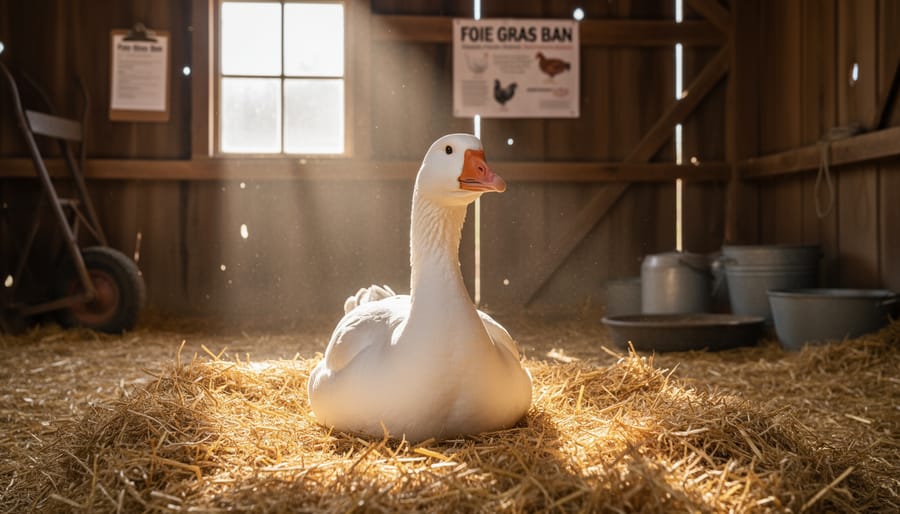
California Health and Safety Code §§ 25980-25984 establishes two distinct prohibitions that form the backbone of California’s foie gras ban. First, the law makes it illegal to force-feed a bird for the purpose of enlarging the bird’s liver beyond normal size. This targets the production method known as gavage, where a tube is inserted down a duck or goose’s throat to deliver large quantities of grain multiple times daily. The statute does not ban all force-feeding practices categorically; it specifically prohibits the act when done to artificially enlarge the liver, which is the defining characteristic of foie gras production.
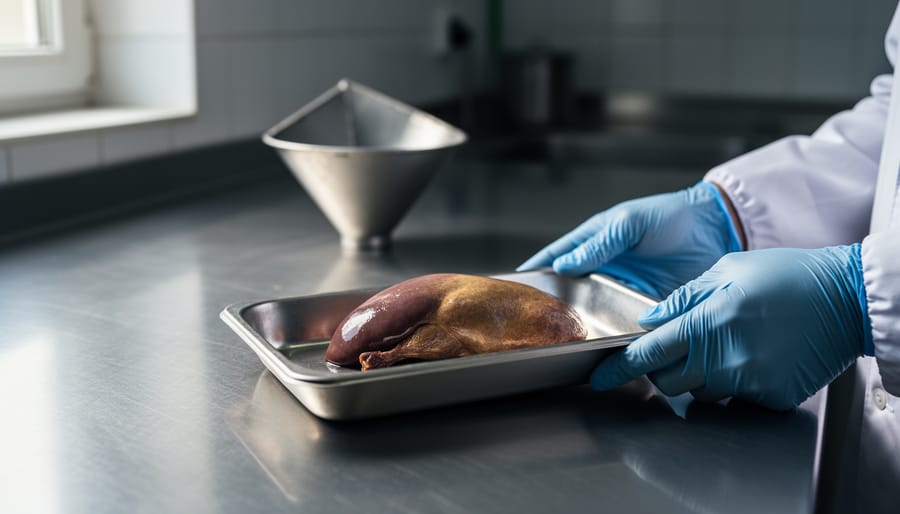
Second, the law prohibits any person from selling products that result from this force-feeding process. This means restaurants, retailers, distributors, and anyone engaged in commerce cannot legally offer foie gras for sale within California’s borders, regardless of where the product was produced. The sale prohibition applies to the final product itself, the enlarged liver, and to preparations derived from it, such as foie gras pâté or torchon.
What counts as illegal sale under the statute? Any transaction where foie gras changes hands for value within California violates the law. This includes restaurant service, retail grocery sales, online orders fulfilled within the state, and wholesale distribution to California businesses. The law does not exempt prepared dishes or processed forms; if the product originated from force-feeding a bird to enlarge its liver, selling it in California is prohibited.
Importantly, the statute targets commercial activity. While the law prohibits production and sale, it does not explicitly criminalize personal possession or consumption of foie gras by individuals. The enforcement focus remains on businesses and individuals engaged in the production or commercial distribution of these products, which has shaped how California authorities approach compliance and penalties.
Timeline: From Enactment to Enforcement

California’s foie gras law followed a winding path from initial passage to full enforcement, marked by legislative intent, a long implementation delay, and years of legal challenges. The timeline reveals how animal protection laws can face sustained resistance even after enactment, and how appellate review ultimately determines their scope and durability.
Governor Arnold Schwarzenegger signed Senate Bill 1520 into law on September 29, 2004, making California the first state to prohibit force-feeding birds for foie gras production and the sale of resulting products. Lawmakers built in an extended compliance period, delaying enforcement until July 1, 2012. This seven-and-a-half-year window was intended to give producers time to transition, though in practice it allowed opponents to organize legal challenges. When the ban took effect in mid-2012, restaurants across the state removed foie gras from menus, and production within California ceased.
The law did not stand unchallenged. Industry groups and producers filed suit, arguing that federal poultry inspection regulations preempted California’s sale prohibition. On January 7, 2015, U.S. District Judge Stephen V. Wilson agreed, ruling that the Poultry Products Inspection Act prevented states from imposing additional labeling or ingredient requirements on federally inspected poultry products. His decision enjoined enforcement of the sale ban, though the production prohibition remained intact. Restaurants resumed offering foie gras during this period of uncertainty.
| Date | Event | Legal Outcome |
|---|---|---|
| September 29, 2004 | SB 1520 signed into law | Ban enacted with delayed enforcement |
| July 1, 2012 | Law takes effect | Production and sale prohibited statewide |
| January 7, 2015 | U.S. District Court ruling | Sale ban enjoined; production ban upheld |
| September 15, 2017 | Ninth Circuit reversal | Full ban reinstated on appeal |
| January 7, 2019 | Supreme Court denies certiorari | Ban becomes final and enforceable |
The Ninth Circuit Court of Appeals reversed Judge Wilson’s preemption ruling on September 15, 2017, finding that California’s law regulated conduct (force-feeding) rather than product standards, and thus fell outside the scope of federal preemption. Industry groups petitioned the U.S. Supreme Court, but on January 7, 2019, the Court denied certiorari without comment. That denial left the Ninth Circuit’s decision in place, ending the legal battle and restoring full enforcement of both the production and sale prohibitions.
From 2019 forward, the ban has remained in effect without further judicial intervention. The fourteen-year journey from enactment to final resolution illustrates the persistence required to defend animal protection statutes and the critical role appellate courts play in interpreting federalism boundaries.
The Legal Rationale Behind the Ban
California lawmakers grounded the foie gras ban in a straightforward principle: deliberately inflicting unnecessary suffering on animals to produce luxury food products violates the state’s commitment to animal welfare. The legislative record reveals that concerns about the force-feeding process, known as gavage, drove the prohibition. This practice involves inserting a metal or plastic tube down a duck or goose’s throat multiple times daily to pump large quantities of grain directly into the stomach, causing the liver to swell to roughly ten times its normal size. Proponents of the ban argued that this intensive feeding regime causes physical trauma, including esophageal injuries, impaired liver function, respiratory distress, and chronic stress.
The animal cruelty argument extended beyond the mechanical act of force-feeding to the conditions under which it occurs. Birds raised for foie gras production are typically confined in ways that restrict natural behaviors, compounding the welfare concerns. California legislators determined that the combined effect of confinement and repeated forced feeding crossed the threshold from acceptable agricultural practice to unnecessary suffering, particularly when the sole purpose is producing a delicacy rather than meeting basic nutritional needs.
This rationale aligned with California’s established animal protection framework, which had already addressed cruelty in various contexts through criminal statutes and agricultural standards. The foie gras law represented an extension of that framework into the farmed animal sector, acknowledging that animals raised for food deserve legal and humane treatment even within commercial production systems. By prohibiting both the production process and the sale of resulting products, lawmakers sought to eliminate California’s market participation in practices they deemed ethically indefensible.
The law’s passage reflected a broader shift in public consciousness about farmed animal welfare and the role legal mechanisms can play in setting ethical boundaries for food production. Organizations working to protect farmed animals through strategic litigation and legislative advocacy view California’s foie gras ban as evidence that legal action can translate ethical concerns into enforceable standards, establishing precedents that influence animal protection efforts nationwide. The ban demonstrated that states possess authority to regulate agricultural practices based on animal welfare grounds, even when those practices remain legal elsewhere.
Enforcement, Penalties, and Compliance
California’s foie gras ban operates through a multi-agency enforcement framework, though practical enforcement has proven sporadic and reactive rather than systematic. The California Department of Food and Agriculture holds primary authority under Health and Safety Code §§ 25980-25984, while local health departments and district attorneys can also pursue violations. Because foie gras enforcement typically ranks low among competing regulatory priorities, most cases emerge from public complaints, media reports, or animal protection groups documenting illegal sales rather than routine inspections.
Violations that trigger enforcement fall into three categories: producing foie gras within California (force-feeding birds to enlarge their livers), selling foie gras products to California consumers, and distributing or facilitating the sale of such products. Each violation can result in a misdemeanor conviction and a civil penalty of up to $1,000 per occurrence. For restaurants, this means every plate of foie gras sold technically constitutes a separate violation, creating significant cumulative exposure for establishments that openly flout the law. However, criminal prosecutions remain rare; most enforcement actions result in cease-and-desist orders or civil settlements.
Compliance challenges center on interstate commerce loopholes and enforcement gaps. Some restaurants have attempted workarounds, such as “gifting” foie gras with the purchase of an expensive side dish or claiming products originated before the ban took effect, but these tactics carry legal risk. Most California restaurants and retailers adapted by removing foie gras from menus and shelves after the ban’s 2012 implementation and again following the Supreme Court’s 2019 certiorari denial. Chefs who wish to understand these restrictions within the broader context of animal law basics find that California’s statute represents one of the more specific product bans in farmed animal protection, creating clear compliance obligations but limited precedent for gray-area scenarios.
Legal Challenges and Federal Preemption Arguments

California’s foie gras ban survived one of the most significant legal tests in modern animal protection law. The controversy centered on whether federal regulations governing poultry products prevented California from enforcing its own sales prohibition.
On January 7, 2015, U.S. District Judge Stephen V. Wilson struck a major blow to the ban’s enforcement. He ruled that California’s prohibition on selling foie gras was preempted by the federal Poultry Products Inspection Act (PPIA). The PPIA establishes uniform standards for poultry product labeling and inspection across the United States. Judge Wilson determined that California’s sales ban effectively imposed additional requirements on products already approved under federal inspection standards, creating a conflict that federal law must resolve. His ruling didn’t challenge California’s authority to prohibit force-feeding within state borders, but it blocked enforcement of the sales component, allowing restaurants to resume importing and serving foie gras from out-of-state producers.
The industry’s victory proved short-lived. On September 15, 2017, the Ninth Circuit Court of Appeals reversed Judge Wilson’s decision. The appellate court distinguished California’s law from regulations that would conflict with federal inspection authority. The PPIA preempts state laws that impose different ingredient standards or labeling requirements for federally inspected products. California’s statute, however, didn’t dictate how foie gras should be produced or labeled. It banned an entire category of product based on the production method, an exercise of traditional state police powers over animal welfare and public morals. The Ninth Circuit found this distinction critical: states retain authority to prohibit products altogether for ethical reasons, even when those products bear federal inspection stamps.
The legal battle reached its conclusion on January 7, 2019, when the U.S. Supreme Court denied certiorari, declining to hear the industry’s appeal. This denial left the Ninth Circuit’s ruling as the final word, confirming California’s full authority to enforce both the production and sales prohibitions.
The Supreme Court’s refusal to intervene carries profound implications for animal protection statutes nationwide. It affirms that states can regulate commerce in animal products based on ethical production standards without running afoul of federal inspection regimes. This precedent strengthens the legal foundation for other state-level animal welfare laws that similarly prohibit sales of products from practices deemed cruel, demonstrating how strategic litigation preserves and advances protections for farmed animals.
Implications for Animal Law and Advocacy
California’s foie gras ban represents a watershed moment in animal law, demonstrating that states can enact meaningful protections for farmed animals and successfully defend them against well-funded industry opposition. The law’s survival through years of federal preemption challenges established important precedent, affirming that states retain authority to regulate animal welfare even when federal inspection regimes exist. This legal victory has inspired advocates in other jurisdictions to pursue similar prohibitions, with New York City adopting its own foie gras ban in 2019 and activists in additional states citing California’s framework as a template.
Beyond foie gras specifically, the ban’s trajectory illustrates how strategic litigation can shield progressive animal welfare statutes from dismantlement. The federal court battles forced proponents to refine legal arguments about state police powers, federalism, and the scope of the Poultry Products Inspection Act in ways that benefit future animal protection efforts. Each successful defense strengthens the foundation for laws targeting other intensive confinement practices, such as battery cages, gestation crates, and veal crates.
Organizations like Oasis HD advance this work by filing impactful lawsuits that hold violators accountable and by training the next generation of legal professionals to expand animal law as a practice area. Their dual focus on litigation and education ensures that landmark laws like California’s foie gras ban have both immediate enforcement mechanisms and long-term institutional support. As farmed animal protections face increasing scrutiny and opposition, skilled legal advocates become essential to preserving these hard-won gains and building momentum for broader reforms that recognize the welfare interests of billions of animals raised for food.
Frequently Asked Questions
Can you bring foie gras into California from another state for personal consumption?
California’s law prohibits the sale of foie gras within the state but does not explicitly ban personal possession or consumption. However, purchasing foie gras out of state and bringing it into California remains a legal gray area, and retailers cannot sell it to California residents.
Are there any exemptions to California’s foie gras ban?
The law under California Health and Safety Code §§ 25980-25984 contains no exemptions for restaurants, retailers, or producers. Both the force-feeding of birds and the sale of resulting products remain prohibited regardless of where the foie gras was produced.
What penalties does a restaurant face if caught selling foie gras?
Restaurants and individuals found in violation of the ban face civil penalties, though specific enforcement mechanisms vary. Questions around compliance and enforcement typically involve state authorities investigating reported violations and issuing fines to violators.
How does California’s ban compare to laws in other jurisdictions?
California remains one of the few U.S. states to prohibit foie gras production and sale, alongside New York City’s ban that took effect in 2022. Internationally, several countries including the United Kingdom and Germany have banned force-feeding, though enforcement standards differ significantly from California’s approach to housing compliance and commercial regulation.
These questions reflect the practical concerns of consumers, businesses, and advocates navigating California’s foie gras prohibition. The ban’s legal clarity on production and sale contrasts with ambiguities around personal possession, creating ongoing debates about enforcement priorities. As animal protection law evolves, California’s statute serves as a reference point for jurisdictions considering similar restrictions on products derived from practices deemed inhumane.
As of 2026, foie gras remains illegal to produce and sell in California under Health and Safety Code §§ 25980-25984. This prohibition stands firm following a protracted legal battle that concluded with the U.S. Supreme Court’s denial of certiorari on January 7, 2019. The ban represents a significant milestone in animal welfare law, demonstrating how sustained legal advocacy can secure meaningful protections for farmed animals against industrial cruelty. California’s law has influenced other jurisdictions and strengthened the foundation of state animal law by affirming that states retain authority to regulate production practices based on ethical and welfare concerns. For those committed to animal protection, supporting organizations that litigate and defend such statutes is essential. Staying informed about evolving animal protection legislation ensures advocates and legal professionals can respond effectively to emerging challenges and expand the reach of these critical safeguards.